Trump's Ultimate Disgrace
His presidency has diminished confidence in American exceptionalism, the American Dream, and democracy.

This newsletter is free: Subscribe for more. Or level up to a paid subscription for the daily “Morning Read-In” (MRI), where I curate the most compelling stories on politics, culture, communications, and life — with micro-essays of insight via the Subscriber-only chat feature.
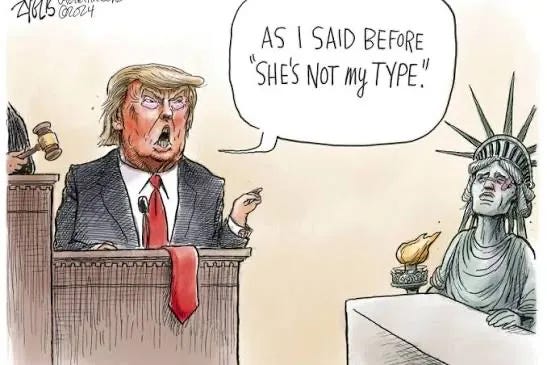
TURNS OUT it matters when the president of the United States calls his country a disaster, fabricates allegations of election fraud, and tramples on democratic institutions, a new poll suggests.
President Trump’s rhetoric and policies are eroding Americans’ pride in their nation, their commitment to democracy, and their faith in the American dream. History will judge these as his ultimate disgrace.
Only about one-quarter of Americans say the U.S. stands above all other countries in the world, according to a poll by The Associated Press-NORC Center for Public Affairs Research. About 3 in 10 say there are better countries than the U.S., an increase from 19% in an AP-NORC poll conducted in June 2016, the year President Trump was first elected in a campaign that cast him as the sole savior from “an American carnage.”
While the poll’s authors don’t draw a direct line between Trump’s presidency and these depressing results, I do. It’s unmistakable, unavoidable. And while the Democratic Party isn’t helping matters, Trump’s two terms in office brought these numbers down.
Americans remain divided about whether diversity is an essential feature of the U.S.’s identity, and agreement about other aspects of the country’s underlying character appears to be eroding, the survey found. Americans are less likely to see a democratically elected government as “extremely” or “very” important to the United States’ identity as a nation than they were just a few years ago. About two-thirds of U.S. adults now say a democratically elected government is highly important to the U.S.’s identity as a nation, down from 80% in 2021.
Young adults are much less likely than older Americans to believe the U.S. is exceptional or to see democracy as critical to the American identity.
About 4 in 10, 44%, of U.S. adults under 30 say there are other countries better than the U.S., compared with 22% of U.S. adults ages 60 and older.
Fewer, too, see democracy as a key element of the U.S.’s identity. Only about half of Americans under 30 believe this, compared with 81% of those 60 and older.
Fleshing out the data, the AP talked to voters. Derricka Wall, 24, of Chickasaw, Alabama, said democracy is not the problem. “It’s the people that are actually being put in office that is the problem.”
Wall said the people who established the government with co-equal branches thought they were erecting safeguards to keep any one person or group from attaining too much power. But she believes they didn’t foresee how easily those guardrails would crumble if the people in the system stopped enforcing them.
“I feel like they would actually roll out of their graves,” she said. “I feel they would be very disappointed in us.”
Kent Stage, 62 and a retired senior enlisted man in the Army, is a registered Republican in Indiana. “I’ll trust the ambulance-chasing lawyer and a shady used car salesman before I trust the politician,” he told AP.
The survey also finds widespread cynicism about America as the land of opportunity. About half of U.S. adults, 51%, say the American Dream — the idea that if you work hard, you’ll get ahead — once held true but does not anymore. About one-third say it “still holds true” while 15% say it never held true.
Jack Hermanson, a 27-year-old software developer in Denver, said his belief in the American Dream changed when he saw his engineer husband struggle to find a job. “That really shattered my impression that if you work hard, you get what you deserve,” Hermanson said.
Only 22% of Americans under 30 say the American Dream still holds true, compared with 46% of Americans ages 60 and older.
FIGHTING FOMO: This item first appeared in today’s “Morning Read-In.” Unless you’re a paid subscriber to Convulsions, you also missed these stories:
How Trump’s disregard for women impacts his government.
Two reasons why later-born siblings face more challenges than first-borns.
The price Earl “The Pearl” Monroe paid for his Hall of Fame career.
An “AI Lab Rat” offers tips to surviving the tech revolution.
What the downing of two U.S. pilots might mean for the U.S. war on Iran.
Paid subscribers are what keeps Convulsions cooking, which is why I created the daily MRI just for them. Consider joining! I can’t do this without you.