
AI Didn't Write This
But maybe it should have?


This is a reader-supported Substack for and about you — witnesses to an age of acrimony and anxiety.
These newsletters are free. A paid subscription also gives you access to “The Morning Read-In,” a daily curation and conversation around the day’s most compelling stories on politics, culture, communications, and life. Today’s newsletter draws from an item in the MRI.
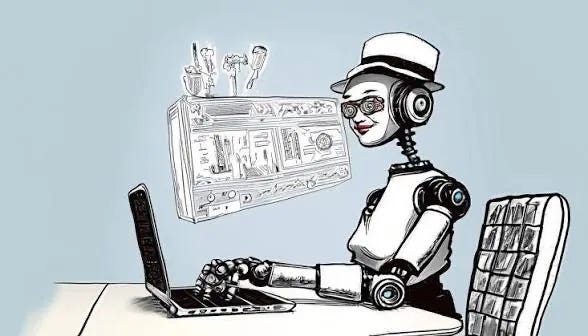
I AM GLAD I became a journalist when I did — in 1985, a half generation before the internet went public, two decades before it went social, and 40 years before artificial intelligence robbed reporters of at least half the job.
Chris Quinn, editor of the once-mighty Cleveland Plain Dealer, posted a column Saturday proudly declaring that AI writes for his reporters:
Because we want reporters gathering information, these jobs are 100 percent reporting. We have an AI rewrite specialist who turns their material into drafts. We fact-check everything. Editors review it. Reporters get the final say. Humans — not AI — control every step.
By removing writing from reporters’ workloads, we’ve effectively freed up an extra workday for them each week. They’re spending it on the street — doing in-person interviews, meeting sources for coffee. That’s where real stories emerge, and they’re returning with more ideas than we can handle.
I wonder what wrote this column for Quinn. Chat GPT? Claude? Surely it wasn’t Quinn, who opened his column by chastising a college student who withdrew her application to be a reporter at the Plain Dealer “because of how we use artificial intelligence.”
Like many students we’ve spoken with in the past year, this one had been told repeatedly by professors that AI is bad. We heard the same thing at the National Association of Black Journalists convention in Cleveland in August. Student after student said it.
That’s backwards — and it seriously handicaps them as they begin their careers. I’ve written extensively about how we use AI to do more and better work. It has quickly become critical to everything we do, and to our success.
What Quinn failed to mention is that local news coverage is a faint shadow of 20th century journalism. Almost 40% of all local U.S. newspapers have vanished in the last 20 years, according to Northwestern University’s Medill School of Journalism, leaving 50 million Americans with limited or no access to a reliable source of local news. More than 130 papers shut down in the past year alone. News deserts — areas with extremely limited access to local news – continue to grow: In 2005, about 150 counties lacked a source of local news; today, there are more than 210.
Medill cites several factors for the crisis: “shrinking circulation and steep losses of revenue from changes to search and the adoption of AI technologies, while political attacks against public broadcasters threaten to leave large swaths of rural America without local news.”
Quinn says AI is improving local journalism. Medill says the opposite.
Where do I come down? A bit more Medill than Quinn.
First, journalists today can’t turn back the clock. They must adapt and adopt new technology to squeeze every ounce of accountability journalism out of their shrinking budgets. AI is an extraordinary research tool and it exponentially reduces the time required to write clear, concise, and compelling stories.
Quinn is correct to say that any journalism school discouraging students from using AI is doing a disservice to the profession.
Second, news executives can’t pretend AI is the answer. While artificial intelligence might help newsrooms like the Plain Dealer slow or mitigate the death of vibrant independent journalism in U.S. towns and cities, AI will not rebuild newsrooms to their former size, scope or positive impact.
And even the most advanced AI program cannot replace the judgement and critical thinking required to produce unbiased, unfiltered news and information that holds powerful people accountable. Indeed, modern technology is more likely to feed readers what they know or want to know — confirming biases with data-derived pablum rather than broadening minds with uncomfortable truths.
“AI can help draft stories, but it cannot sit across from someone, make eye contact and build trust,” writes Quinn. Or was it Claude?
ALSO PUBLISHED in today’s “Morning Read-In” for paid subscribes were stories on:
One woman’s gift of grief and loss.
America’s surrender to climate change.
What Teddy Roosevelt’s descendants think of today’s GOP.
On Presidents Day, former President George W. Bush’s shot across the bow.
To get the MRI every morning before dawn, and to support my work at Convulsions, please consider a paid subscription: $5/month or $50/year.
I can’t keep doing this without you.
Jesus this is depressing. Tight, punchy prose is a hallmark of excellent journalism. Look at Charles Bowden's crime writing for the Tucson Citizen, or Ernie Pyle's columns during WW2. Hell, Woodward and Bernstein were hammer-and-nails guys who could write the hell out of things.
American prose has its roots in journalism, most notably in the backgrounds of John Steinbeck and Ernest Hemingway. Cub reporters filing stories is the backbone of "I was educated at the public library" writing. David Simon is another recent example. It's why they write real shit.
How the hell is somebody supposed to learn how to write good prose without having to shell out 50k for an MFA that tells you that writing a memoir at 25 is a good idea?
We have great journalists out there who are dedicated to the craft of writing grammatically correct prose that quickly tells the story in inverted-pyramid fashion. They understand the importance of context both compelling and crucial, as it was with Jen Percy's excellent Atlantic story about the female Afghan warlord or Martha Gellhorn's war reporting (way better than Hemingway's, BTW).
What would Ben Bradlee think of this shit? Not that Bezos would let him keep his job, but hey.
The grief about what journalism was is real.
I wrote an entire section honoring it.
My in-laws owned newspapers.
I still read the paper every morning.
But Woodward didn't refuse the photocopier because hand-copying Library of Congress slips was more pure.
The tool changed.
The judgment didn't.
The full piece is here: https://tmaark.substack.com/p/im-ai